Thread
matters
more
than
most
hobby
quilters
realise.
A
reliable
50wt
cotton
thread
is
my
go-to
for
quilt
piecing
because
it:
Presses
flat
Reduces
seam
bulk
Produces
less
lint
Holds
up
beautifully
over
time
Cheap
thread
often
causes
tension
problems,
breakage,
and
frustration
that
gets
blamed
on
the
machine.
If
you’re
upgrading
one
quilting
supply
this
year,
make
it
your
thread.
5.
Fine
Glass
Head
Pins
(For
Accurate
Piecing)
Not
all
quilting
pins
are
equal.
Fine
glass
head
pins:
Slide
easily
through
quilting
cotton
Don’t
distort
fabric
Can
handle
pressing
heat
If
your
seams
shift
while
sewing,
bulky
pins
might
be
part
of
the
problem.
Accurate
quilting
often
comes
down
to
small
details
like
this.
6.
Removable
Fabric
Marking
Tool
(No
Bleeding,
No
Ghosting)
Every
quilter
has
a
marking
disaster
story.
The
key
is
using
quilting
marking
tools
that
are
designed
specifically
for
fabric.
I
keep:
A
water-soluble
fabric
pen
Tailor’s
chalk
for
darker
fabrics
Temporary
fabric
marking
tools
make
straight-line
quilting,
block
placement,
and
design
planning
much
easier
—
without
permanently
staining
your
quilt.
Always
test
on
scrap
fabric
first.
Always.
7.
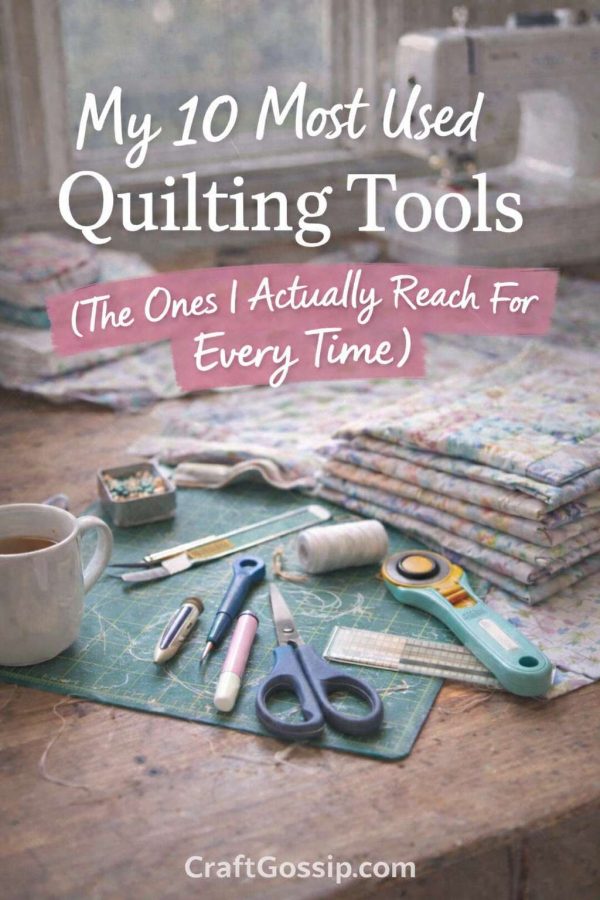
Seam
Ripper
(The
Honest
Quilter’s
Best
Friend)
Let’s
not
pretend.
Even
experienced
quilters
use
a
seam
ripper
regularly.
A
sharp,
comfortable
seam
ripper:
Removes
stitches
cleanly
Prevents
fabric
damage
Saves
time
during
corrections
I
keep
one
next
to
my
sewing
machine
and
one
in
my
notions
tin.
Because
I’m
realistic.
8.
Quilting
Needles
(Changed
Regularly)
Using
the
correct
quilting
needle
makes
a
huge
difference
in
stitch
quality.
For
most
piecing
with
50wt
thread,
I
use:
80/12
quilting
or
universal
needles
If
I’m
quilting
through
thicker
layers,
I
move
up
to:
90/14
needles
Changing
your
sewing
machine
needle
regularly
is
one
of
the
simplest
ways
to
improve
stitch
consistency.
Skipped
stitches?
Change
the
needle
first.
9.
Pressing
Tools
(Because
Pressing
Is
Half
the
Battle)
Pressing
—
not
ironing
—
is
what
gives
quilts
that
professional
finish.
My
most
used
pressing
supplies
include:
A
reliable
iron
A
stable
pressing
surface
or
wool
mat
Flat
seams
=
accurate
blocks.
If
your
quilt
blocks
don’t
measure
correctly,
pressing
technique
and
tools
are
often
the
reason.
10.
A
Small
Notions
Storage
Container
This
sounds
simple,
but
it’s
one
of
my
most
practical
quilting
organisation
tips.
It
really
doesn’t
matter
what
it
looks
like,
jsut
has
to
be
functional.
Inside
mine:
Extra
rotary
blades
Machine
needles
Pins
Small
snips
Marking
tools
Having
your
essential
quilting
notions
contained
in
one
place
keeps
projects
flowing
and
prevents
mid-project
hunting
sessions.
And
that
alone
reduces
stress.
Quilting
Tools
I
Don’t
Use
as
Often
Just
to
keep
it
honest
—
I
don’t
reach
for:
Dozens
of
specialty
rulers
Large
collections
of
thread
colours
Trendy
quilting
gadgets
Complicated
templates
(unless
the
pattern
requires
them)
For
hobby
quilting,
simple
essential
quilting
tools
used
consistently
are
far
more
valuable
than
a
cluttered
workspace.
If
I
Had
to
Rebuild
My
Quilting
Supplies
from
Scratch
(god
forbid)
If
I
were
starting
over
and
building
a
basic
quilting
toolkit,
I’d
buy:
That’s
it.
Everything
else
can
grow
with
your
skills.
If
you’re
trying
to
simplify
your
quilting
supplies
or
wondering
which
quilting
tools
are
actually
necessary,
start
with
what
you’ll
use
every
single
project.
Because
beautiful
quilts
aren’t
made
with
the
most
tools.
They’re
made
with
the
right
ones.
About the Author
admin
This is a website that that is passionate about all things hand crafted, including hang made scarves, fishing, and gardening, scrapbooking, and even woodworking.
We have some handy advice and tips, you can read.