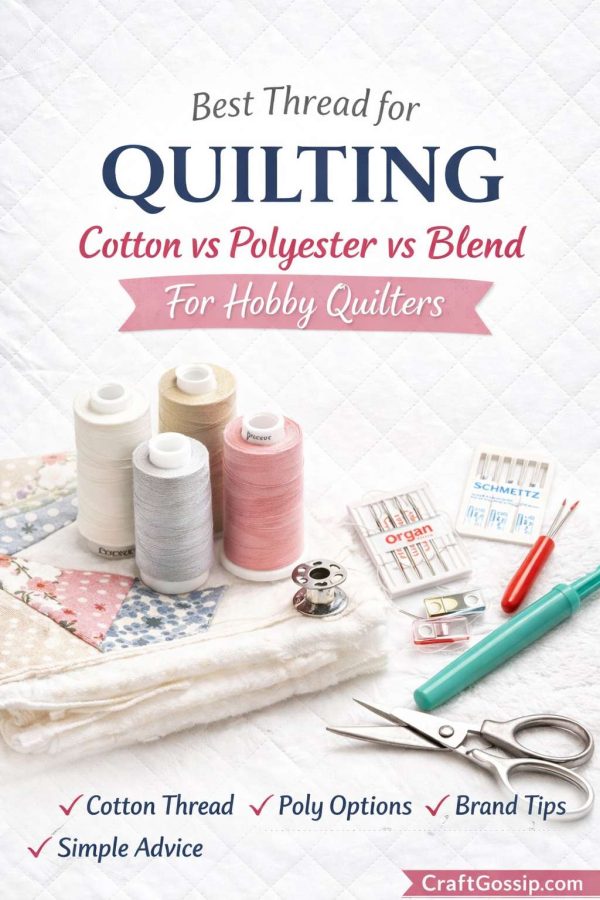
Best Thread for Quilting: Cotton vs Polyester vs Blend (For Hobby Quilters)
If
you’ve
ever
had
thread
snap
mid-seam,
create
lint
fuzz
in
your
machine,
or
leave
your
quilt
feeling
stiff…
you
already
know
thread
matters
more
than
we
think.
When
I
first
started
quilting,
I
grabbed
whatever
spool
was
closest.
Thread
was
thread,
right?
Not
quite.
The
truth
is,
the
thread
you
choose
affects:
Seam
strength
Bulk
in
your
blocks
Stitch
definition
Lint
build-up
Long-term
durability
And
for
hobby
quilters
—
the
ones
making
a
few
meaningful
quilts
a
year
—
you
don’t
need
20
types
of
thread.
You
just
need
the
right
ones.
Let’s
break
it
down
simply.
Why
Thread
Weight
Actually
Matters
When
you
see
“50wt”
or
“40wt”
on
a
spool,
that
number
refers
to
thread
thickness.
Here’s
the
easy
rule:
The
higher
the
number,
the
finer
the
thread.
For
piecing
quilt
blocks,
most
experienced
hobby
quilters
prefer
50wt
thread.
It’s
fine
enough
to
reduce
bulk
in
seams,
which
helps
your
points
match
better
and
blocks
lie
flatter.
Heavier
threads
(like
40wt)
are
often
used
for
visible
quilting
because
they
show
up
more
prominently
on
the
surface.
If
your
seams
feel
bulky
or
your
points
don’t
quite
align,
thread
weight
might
be
part
of
the
problem.
Cotton
thread
is
the
traditional
favourite
for
quilting
—
and
for
good
reason.
It:
Presses
flat
Grips
fabric
nicely
Blends
well
with
cotton
quilting
fabric
Creates
a
classic
finish
High-quality
cotton
thread
(like
50wt
long-staple
cotton)
produces
less
lint
and
smoother
stitching
than
cheaper
cotton
options.
For
hobby
quilters
making
quilts
for
family,
gifting,
or
keepsakes,
cotton
thread
is
often
the
safest,
most
versatile
choice.
Best
for:
Piecing
quilt
tops
Traditional
quilting
Heirloom
projects
Polyester
thread
is
stronger
than
cotton
and
produces
less
lint.
It
also
has
a
slight
stretch,
which
can
add
durability
—
especially
for
bed
quilts
that
will
be
washed
often.
Some
quilters
prefer
polyester
for
machine
quilting
because
it
glides
smoothly
and
holds
tension
well.
However,
it
can
feel
slightly
stiffer
than
cotton
and
may
not
press
as
flat
in
seams.
Best
for:
Utility
quilts
Quilts
that
will
be
washed
frequently
Machine
quilting
with
high
speed
Cotton-Poly
Blends:
The
Middle
Ground
Blended
threads
combine
the
softness
of
cotton
with
the
strength
of
polyester.
For
hobby
quilters
who
want
durability
without
sacrificing
that
classic
cotton
look,
blends
can
be
a
practical
compromise.
They’re
especially
helpful
if:
You’ve
had
cotton
thread
break
on
your
machine
You
want
reduced
lint
You’re
quilting
multiple
layers
What
About
Thread
Brands?
Not
all
threads
are
created
equal.
Quality
affects
smoothness,
breakage,
and
lint
levels.
Many
hobby
quilters
gravitate
toward
premium
long-staple
cotton
threads
because
they
produce
cleaner
stitches
and
less
frustration.
If
you’re
upgrading
from
budget
thread
and
noticing
tension
issues,
skipped
stitches,
or
excessive
lint
—
it
might
not
be
your
machine.
It
might
simply
be
thread
quality.
When
browsing
quilting
thread
options,
look
for:
Consistent
thickness
Minimal
fuzz
Strong
but
smooth
feel
Clear
weight
labeling
You
can
explore
a
wide
selection
of
quilting
threads
—
including
cotton,
polyester,
and
blends
—
through
specialty
quilting
retailers
like
Fat
Quarter
Shop’s
thread
collection,
which
makes
it
easy
to
compare
weights
and
fibre
types
in
one
place.
Thread
for
Piecing
vs
Thread
for
Quilting
Here’s
where
hobby
quilters
often
get
confused.
You
do
not
need
different
thread
for
everything.
But
you
may
want
to
consider:
For
piecing:
50wt
cotton
Neutral
shades
(light
grey,
cream,
soft
taupe)
For
quilting
(the
stitching
through
all
layers):
40wt
or
50wt
depending
on
visibility
preference
Contrasting
colours
if
you
want
stitching
to
show
If
you
only
want
one
all-purpose
thread?
Choose
a
high-quality
50wt
cotton
in
a
neutral
shade.
It
handles
most
hobby
quilting
needs
beautifully.
How
Thread
Affects
Your
Quilt
Long-Term
This
part
doesn’t
get
talked
about
enough.
Thread
becomes
part
of
the
structure
of
your
quilt.
Over
time,
low-quality
thread
can
weaken,
especially
if
exposed
to
washing
and
sunlight.
For
quilts
meant
to
last
—
baby
quilts,
wedding
gifts,
memory
quilts
—
thread
quality
is
part
of
durability.
You
don’t
need
the
most
expensive
option
on
the
market.
But
consistent,
reliable
thread
makes
a
noticeable
difference
over
years.
Signs
It’s
Time
to
Upgrade
Your
Thread
Frequent
breakage
Excessive
lint
in
your
bobbin
area
Tension
struggles
that
won’t
resolve
Seams
that
feel
stiff
Visible
fuzz
on
finished
blocks
Sometimes
we
blame
our
machines
when
it’s
really
the
spool.
The
Bottom
Line
for
Hobby
Quilters
You
do
not
need
a
wall
of
thread
colours.
Start
with:
A
high-quality
50wt
cotton
for
piecing
A
slightly
heavier
option
if
you
love
visible
quilting
texture
Neutrals
first,
then
build
your
colour
collection
slowly
Thread
is
one
of
the
simplest
upgrades
you
can
make
—
and
one
of
the
most
noticeable.
This
article
is
part
of
our
Ultimate
Guide
to
Quilting
Notions
for
Hobby
Quilters.
If
you
haven’t
read
the
full
guide
yet,
it
walks
through
all
the
essential
tools
that
make
quilting
smoother,
more
accurate,
and
more
enjoyable.
Next
month
in
the
series:
Rotary
Cutters
Explained:
Sizes,
Blades,
and
When
to
Replace
Them,
About the Author
admin
This is a website that that is passionate about all things hand crafted, including hang made scarves, fishing, and gardening, scrapbooking, and even woodworking.
We have some handy advice and tips, you can read.