If your stitches are skipping, your thread keeps breaking, or your fabric looks slightly chewed… I’m going to gently suggest something.
It might not be your machine.
It might be your needle.
Needles are one of the most overlooked quilting notions. They’re small, inexpensive, and easy to ignore — until they start causing problems.
For hobby quilters, understanding just a few basics about needle type and size can completely change your sewing experience.
Let’s simplify it.
Your needle:
Pierces fabric thousands of times
Carries thread through layers
Affects stitch quality
Influences tension
Impacts fabric damage
A dull or incorrect needle can cause:
Skipped stitches
Thread shredding
Uneven tension
Puckering
Tiny fabric holes
And because needles wear gradually, you often don’t realise performance has declined.
How Often Should You Change Your Needle?
Most hobby quilters don’t change needles often enough.
A good rule: Change your needle every 1–2 quilt projects.
Or sooner if you notice:
A popping sound while stitching
Skipped stitches
Thread breakage
Visible fabric pulls
Needles dull faster than we think — especially when quilting through batting and multiple layers.
Needle Sizes Explained (Without the Confusion)
Needles have two numbers, like 80/12 or 90/14.
The first number (European sizing) refers to the shaft diameter. The second number (American sizing) is the corresponding system. The larger the number, the thicker the needle.
For quilting, most hobby quilters use:
80/12 – Good for piecing with 50wt thread
90/14 – Good for quilting through multiple layers
75/11 – Good for fine thread and lightweight fabric
If you’re unsure, 80/12 is a safe starting point for most cotton quilting projects.
Types of Needles for Quilting
This is where things sound more complicated than they are. Let’s break it down clearly.
Universal Needles
Best for: Basic piecing, general sewing, beginners.
Universal needles work well for most cotton quilting fabrics. If you’re just starting out, they’re perfectly fine.
Quilting Needles
Quilting needles are slightly tapered and designed to:
Reduce fabric damage
Stitch through layers smoothly
Minimize skipped stitches
They’re excellent for detailed piecing and fine quilting work. If you’re serious about accuracy, quilting-specific needles are worth trying.
Microtex (Sharp) Needles
Microtex needles are sharper and finer.
Best for: Precision piecing, tightly woven fabrics, very accurate points.
If you love crisp seams and sharp block points, these are a favourite among experienced hobby quilters.
Topstitch Needles
Topstitch needles have a larger eye.
Best for: Heavier thread, decorative quilting, metallic thread.
If your thread keeps shredding while machine quilting, switching to a topstitch needle can help.
Hand Quilting Needles (Betweens)
If you hand quilt or hand bind:
Betweens needles are short, strong, and designed for rocking stitches. For binding, slightly longer sharps are often more comfortable. Needle choice in hand quilting is very personal — comfort matters.
Matching Needle to Thread
This is where many issues begin.
Fine thread + thick needle = loose stitches Thick thread + fine needle = breakage
As a general guide:
50wt cotton thread → 80/12 needle
Heavier quilting thread → 90/14 needle
Fine detail quilting → 75/11 needle
When thread and needle are compatible, stitching feels smoother immediately.
Signs You’re Using the Wrong Needle
Thread frays or snaps
Tension looks inconsistent
Fabric looks slightly pulled
Machine sounds louder than usual
Stitches don’t look clean
If something feels off, change the needle before adjusting tension settings. It’s the simplest troubleshooting step.
Do Needle Brands Matter?
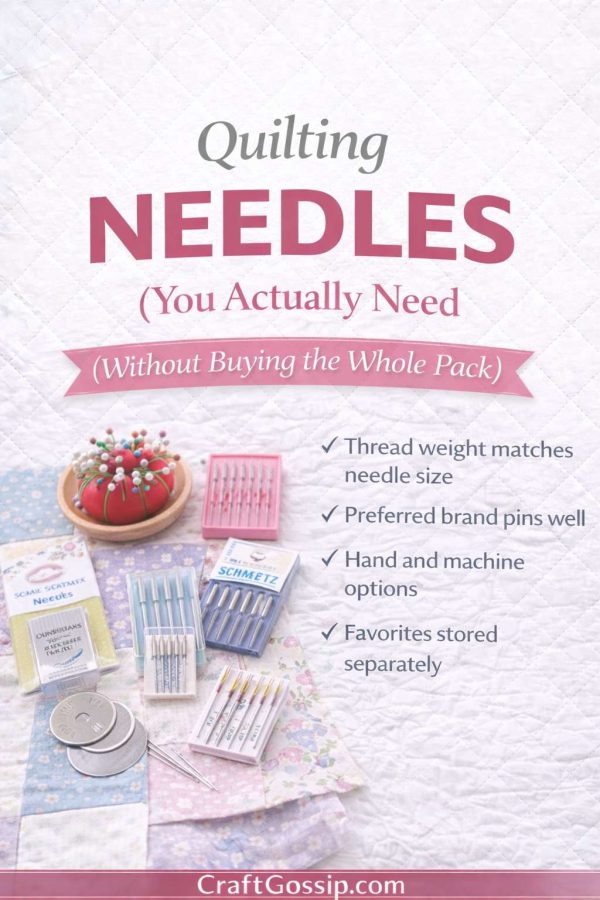
Yes — consistency matters. High-quality quilting needles maintain sharpness longer and produce more reliable stitching.
When browsing quilting needles, look for:
Clear sizing labels
Quilting-specific packaging
Good reputation for durability
Specialty quilting retailers like Fat Quarter Shop carry a range of quilting, Microtex, and topstitch needles, making it easier to choose based on your project rather than guessing at a general sewing aisle.
The Bottom Line for Hobby Quilters
You don’t need every type of needle.
Start with:
80/12 quilting or universal needles
90/14 for thicker projects
Replace regularly
If something feels wrong, change the needle first. It’s the cheapest fix in quilting — and often the most effective.
This article is part of our Ultimate Guide to Quilting Notions for Hobby Quilters.
About the Author
admin
This is a website that that is passionate about all things hand crafted, including hang made scarves, fishing, and gardening, scrapbooking, and even woodworking.
We have some handy advice and tips, you can read.