A Warm, Step-by-Step Guide to a Sparkling New Hobby
Diamond art painting (sometimes called diamond painting or 5D diamond embroidery) is a relaxing, creative craft that almost anyone can enjoy. No drawing or painting skills are required. If you can place stickers, you can do diamond art.
This guide will walk you through:
What diamond art painting is
Tools and materials you will need
Step-by-step instructions to get started
Common mistakes and how to avoid them
How diamond art supports relaxation and creativity
How to choose your first kit
Fun project ideas for home decor and gifts
1. What Is Diamond Art Painting?
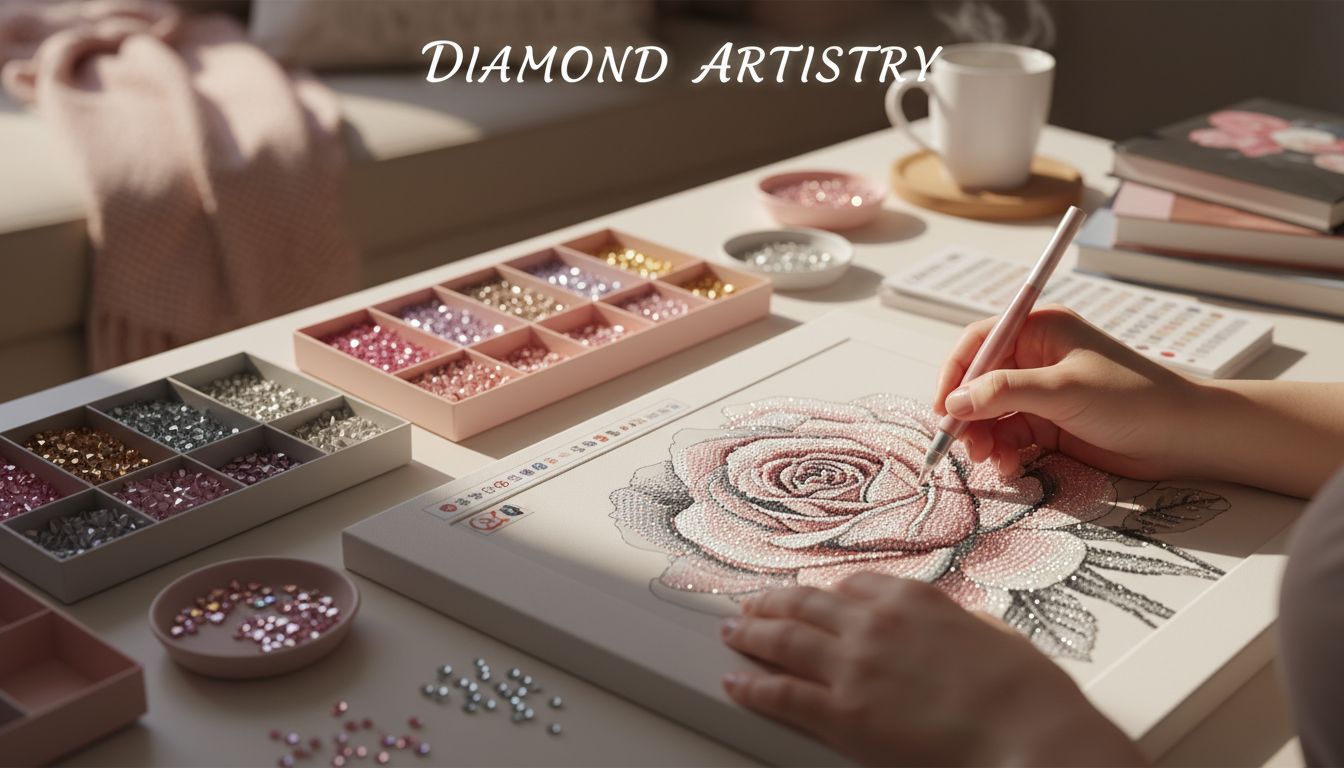
Diamond art painting is a craft where you place tiny, colorful resin “diamonds” onto a sticky, pre-printed canvas to create a sparkling picture.
Think of it as a mix between:
Paint-by-numbers because each area of the picture is labeled with a symbol or number
Cross-stitch or mosaics because you fill in small “squares” or “spots” one by one
How It Works
You get a canvas with a printed design.
The canvas is coated with a layer of adhesive (glue).
Each section on the canvas has a tiny symbol.
Each symbol matches a specific color of diamond drills (the little resin pieces).
You use a pen tool and a bit of wax to pick up each diamond and place it on the matching symbol.
Over time, the picture fills with shiny diamonds and turns into a glittering artwork you can frame, hang, or gift.
Types of Diamond Drills
You will often see the word drills. That is just the craft term for the little diamonds.
There are two main shapes:
Round drills
Circular beads
Easier for beginners
More forgiving if you place them slightly off-center
Square drills
Fit tightly together for a more solid look (no gaps)
Can look more detailed and finished
Require a bit more precision
For your first project, round drills are often the most relaxing and beginner-friendly.
2. Tools and Materials You Will Need
Most diamond painting kits include everything necessary, but it helps to understand what each item is for.
Core Items (Usually Included in Kits)
Printed Canvas
Has the image, symbols, and adhesive already applied
Often covered with a protective plastic film to keep the glue clean
Diamond Drills (Resin Beads)
Tiny, colorful pieces that create the picture
Sorted by color in small bags or packets, often labeled with numbers or codes
Diamond Pen Tool
A pen-shaped tool with a hollow tip
Used to pick up and place the diamonds
Some come with ergonomic grips for comfort
Wax or Putty
Comes in a little square or container
You press the pen tip into the wax so it becomes slightly sticky
Helps the pen pick up the diamonds
Tray or Boat
Small plastic tray where you pour the diamonds
Gently shaking the tray helps diamonds flip right-side up and align in rows
Helpful Extras (Nice to Have)
These may not always be included, but they make your experience smoother:
Storage containers or pill boxes to organize diamond colors
Small labels or stickers to mark each container with symbols or numbers
Light pad a thin, light-up panel that goes under the canvas, making symbols easier to see
Tweezers for placing or adjusting drills, especially squares
Roller or brayer to gently press diamonds down when finished
Washi tape to tape around the canvas edges or cover sections while you work
Cover paper or parchment paper to re-cover sticky areas when you take a break
You do not need all of these to get started, but you may find yourself adding them as you fall in love with the hobby.
3. How to Get Started: Step-by-Step
Here is a simple, beginner-friendly process to complete your first diamond painting.
Step 1: Organize Your Work area.
Choose a clean, flat surface such as a table, desk, or tray table.
Make sure your hands and the surface are clean and dry so dust does not stick to the glue.
If possible, work in a well-lit area to reduce eye strain.
Lay the canvas flat. If it is curled, you can:
Roll it gently in the opposite direction, or
Place it under some heavy books for a few hours
Step 2: Get to Know the Canvas
Look for the legend or chart printed on the side of the canvas.
It shows each symbol and the corresponding diamond color or number.
Take a moment to study where the light and dark areas are.
Decide if you want to start:
In a corner,
In a section of solid color that is easy for beginners, or
With your favorite part of the image which can be motivating and fun
Step 3: Peel Back the Plastic Cover (Slowly)
The adhesive on the canvas is protected by a clear (or sometimes opaque) plastic sheet.
Do not remove the entire plastic at once. This will expose all the sticky area to dust and lint.
Instead, peel back a small section at a time, maybe 3 to 6 inches (8 to 15 cm).
You can fold the plastic back, or cut it into sections for easier access.
Tip: If the plastic is a bit stiff or annoying, you can cover the exposed area with parchment paper or release paper between sessions.
Step 4: Organize Your Diamonds
You can work straight from the little bags, but organizing helps:
Open the bag for the color you will be using first.
Pour some into your tray. Not the entire bag, just enough to work with.
Gently shake the tray side to side so the diamonds line up nicely.
Optional but helpful:
Use small containers for each color.
Label them with the symbol and color number so you do not get confused.
Step 5: Load Your Pen with Wax
Remove any plastic film covering the wax.
Press the tip of the pen straight down into the wax.
A small amount of wax will fill the hollow tip. This makes the pen sticky enough to pick up diamonds.
You will need to refill the wax from time to time as it wears off.
Step 6: Start Placing Diamonds
Pick a symbol in the section you exposed on the canvas.
Find the matching diamond color using the chart.
With your wax-loaded pen:
Touch the top of a diamond in the tray. It should stick to the pen tip.
Carefully press the diamond onto the corresponding symbol on the canvas.
The sticky glue holds the diamond in place when you lift the pen.
Repeat this process, one diamond at a time (or using a multi-placer tool if your pen has one and you are comfortable with it).
Step 7: Work in Small Sections
To avoid messing up the adhesive:
Only uncover small areas of the canvas at a time.
Complete that section, or most of it, before moving to the next.
Cover the area back up if you are taking a longer break.
Working section by section keeps things tidy and prevents dust or hair from sticking to your canvas.
Step 8: Straighten and Secure Your Diamonds
As you work:
Use the pen or tweezers to gently nudge diamonds into straight rows.
Do not worry if they are not perfect, especially with round drills. Small misalignments are hard to see.
When you finish:
Place a clean sheet of parchment paper or the plastic cover over the completed canvas.
Gently roll over it with a roller, a rolling pin, or even a heavy book.
This presses the diamonds firmly into the glue and helps them stay put.
Step 9: Finishing and Framing
Once your work is complete:
Inspect the canvas for:
Missing diamonds
Misplaced colors
Fill in any gaps you see.
Decide how to display it:
Frame under glass (protective but slightly reduces sparkle)
Frame without glass (maximum sparkle; you can seal it if you want extra protection)
Attach to a canvas frame or foam board for a lightweight wall piece
Tip: If you have lots of leftover diamonds, save them for future projects or freestyle crafts such as decorating notebooks or jars.
4. Common Mistakes and How to Avoid Them
Everyone makes mistakes at first. Here are some of the most common ones and simple ways to avoid them.
Mistake 1: Removing the Entire Plastic Cover at Once
Problem: Dust, lint, and pet hair can stick to the exposed glue. It also dries out faster.
Solution: Only peel back a small portion at a time. Cover any unfinished areas when you are not working on them.
Mistake 2: Mixing Up Diamond Colors
Problem: Using the wrong color on an area can be frustrating to fix later.
Solution:
Open and work with one or two colors at a time, especially when you are new.
Use labels and storage containers.
Double-check the symbol and number before pouring diamonds into the tray.
Mistake 3: Losing Stickiness on the Canvas
Problem: The adhesive feels less sticky if touched too often or if it collects dirt.
Solution:
Keep your hands clean and dry.
Avoid touching the sticky area with your fingers.
Work in covered sections to prevent dust buildup.
If an area gets slightly less sticky, you can often still place diamonds. Just press them down firmly. For seriously damaged areas, some crafters very lightly use clear craft glue, but be very careful and test first.
Mistake 4: Crooked or Uneven Diamonds
Problem: Uneven rows can make your work look messy, especially with square drills.
Solution:
Gently push diamonds into alignment as you go, using the pen or tweezers.
Use a straight edge such as a ruler or a card and lightly press along the rows to straighten them.
Do not worry about perfection. Especially with round drills, minor crookedness will not show much.
Mistake 5: Eye Strain and Hand Fatigue
Problem: Long sessions can make your eyes and hands tired.
Solution:
Take short breaks every 20 to 30 minutes.
Use good lighting and, if needed, reading glasses or a light pad.
Hold the pen loosely and relax your grip.
Switch hands occasionally if you are able to.
5. Benefits of Diamond Art for Relaxation and Creativity
Diamond painting is more than just a pretty picture at the end. It can be a truly soothing activity.
Calm and Mindfulness
The repetitive motion of placing diamonds can be meditative.
It encourages focus on the present moment, symbol by symbol.
Many people find it helps reduce daily stress or racing thoughts.
Great for Switching Off
It gives you a screen-free activity to unwind with in the evenings.
You can listen to music, audiobooks, or podcasts while you work.
There is a satisfying sense of progress, even if you only do a few minutes a day.
Boosts Creativity (Even If You Do Not Feel Artistic)
You do not need to draw or paint; the design is already laid out.
Choosing designs that reflect your tastes (nature, animals, abstract, quotes) lets you express your personality.
Over time, you might experiment with custom designs or adding extra sparkle with special drills.
Sense of Achievement
Completing a canvas, big or small, gives a real feeling of accomplishment.
You get something beautiful and tangible at the end, perfect for your home or as a gift.
6. How to Choose Your First Diamond Art Kit
The right first kit makes a huge difference in how enjoyable your experience will be. Here is what to look for.
1. Size of the Canvas
Smaller canvases (20 x 20 cm, 20 x 30 cm, 30 x 40 cm) are best for beginners.
They are quicker to finish, less overwhelming, and great for learning the basics.
Larger canvases offer more detail but take more time and patience. Start small, then move up as you gain confidence.
2. Round vs Square Drills
Round drills
Easier to place
Great for beginners
Ideal for more relaxed projects
Square drills
More detailed and full looking
Require more careful placement
Better as a second or third project
For your first kit, round drills are usually the easiest and most enjoyable.
3. Full Drill vs Partial Drill
Full Drill: Diamonds cover the entire canvas.
Partial Drill: Only part of the image (like the central subject) gets diamonds; the rest is printed background.
For beginners:
Partial drill kits are faster and less intense, great if you are unsure whether you will like the hobby.
Full drill kits are more immersive and give an all-over sparkle.
Both are good. Just decide how big a project you want at first.
4. Design and Image Choice
Choose a design that:
You genuinely love looking at such as nature, animals, flowers, quotes, cartoon characters, and more.
Has clear, not too tiny details if the canvas is small. Highly detailed images on very small canvases can look blurry.
Feels motivating. You will be more likely to finish something that excites you.
5. Quality Considerations
If possible, read reviews or check these points:
Clear symbols on the canvas (not too faint or blurry)
Good adhesive that is not too weak or overly runny
Enough diamonds, with extras; reputable brands usually include spares
A slightly higher quality kit can make your first experience far more enjoyable.
7. Fun Project Ideas for Home Decor and Gifts
Once you are comfortable with diamond painting, there are many ways to enjoy and share your creations.
Home Decor Ideas
Framed Wall Art
Create a set of small canvases in a similar style or color scheme.
Hang them together for a gallery wall effect in your living room, hallway, or bedroom.
Seasonal Decorations
Make holiday-themed paintings for Christmas, Halloween, Easter, and more.
Rotate them with the seasons to refresh your space.
Kitchen or Coffee Corner Art
Choose designs featuring food, coffee, or inspirational quotes.
Hang them near your kitchen table or coffee station.
Kids Rooms
Pick cute animals, cartoon characters, or space themes.
Let older children help with simpler kits. It can be a fun family activity.
Mini Projects Some kits come as:
Bookmarks
Coasters
Keychains
Fridge magnets
These are quick finishes that still add sparkle around your home.
Gift Ideas
Personalized Gifts
Many companies offer custom kits where you upload a photo such as a pet, a special place, or a family picture.
These make wonderful gifts for birthdays, anniversaries, or memorial pieces.
Themed Gifts
For animal lovers: their favorite animal
For a friend who has a new home: a cozy house or “Home Sweet Home” quote
For holiday gifts: festive scenes or meaningful symbols, depending on what they enjoy
DIY Greeting Cards
Some kits include diamond art greeting cards.
Add a handwritten note inside for a unique, sparkly card.
Collaborative Gifts
Work on a painting together with a friend or family member, then gift the finished piece to a loved one.
This turns the crafting time into a shared memory, too.
Gift a Starter Kit
Once you are familiar with the hobby, you can create a starter bundle for someone else:
A simple, small kit
A few extra tools (tray, pen, wax)
A printed copy of basic instructions
8. Gentle Tips to Stay Motivated
If you are completely new to crafting, you might worry you will not finish. Here are a few ways to keep it fun and stress-free.
Start small. A small, simple kit is better than a huge one that makes you feel pressured.
Set tiny goals. For example, “I will complete this one section tonight.”
Enjoy the process, not just the result. Let it be your quiet time.
Do not aim for perfection. Slightly uneven diamonds or tiny mistakes will not ruin your picture.
Celebrate progress. Step back every so often and admire how the image is coming together.
9. Final Thoughts
Diamond art painting is a gentle, beginner friendly craft that blends creativity with calm, repetitive motion. With a few simple tools and a bit of patience, you can turn little resin diamonds into beautiful art for your home or thoughtful handmade gifts.
To get started:
Choose a small, round drill kit with a design you love.
Set up a clean, comfortable workspace.
Work section by section, taking your time and enjoying the process.
Before long, you will have a sparkling finished piece and perhaps a new favorite hobby that brings you both relaxation and joy.
About the Author
admin
This is a website that that is passionate about all things hand crafted, including hang made scarves, fishing, and gardening, scrapbooking, and even woodworking.
We have some handy advice and tips, you can read.